
This blog documents my MBA student life at Ryerson University, Canada (2010-2012). It was an attempt to demystify the MBA experience, help understand MBA topics & encourage MBA wannabes. I have a Pre-MBA blog about B-School application process (and a few other blogs) as well. I used to blog actively in the past and interact with readers regularly, but life got very busy after my MBA. Good luck. Take care. Cheers! Gerry.
Sunday, December 25, 2011


The 1920s era and Roger Babson's prediction of the 1929 crash.


When the crash did happen, banks ran out of money as clients withdrew money while being unable to return their loans. Business went bankrupt. People lost their jobs. Unemployment was almost 25% at the height of the post crash problems in 1933.
Lesson learned---> As Warren Buffet said "Be greedy when others are fearful and fearful when others are greedy". Public sentiment has time-delay and is not always right.

When exactly was the BEGINNING of the housing bubble pop? ----> August 2005 !
People do not know this, but the housing bubble popped long before people realized that it had happened! As is usual, the common man / people on the street are the LAST to know. Here is some info from NAR (National Association of Realtors):
NAR chief economist David Lereah's explanation, "What Happened", from the 2006 NAR Leadership Conference
- Boom ended in August 2005
- Mortgage rates rose almost one point
- Affordability conditions deteriorated
- Speculative investors pulled out
- Homebuyer confidence plunged
- Resort buyers went to sidelines
- Trade-up buyers went to sidelines
- First-time buyers priced out of market

$ 5 Billion Song --> A Deustche Bank Trader Wrote A Song About "The Crappy CDO Business" To A Tune By Vanilla Ice
From the link: http://articles.businessinsider.com/2011-04-14/wall_street/30070423_1_cdos-yo-spreads

Rocky Kurita, set CDO business to a song, “CDO Oh Baby,” by Vanilla Ice with the following lyrics:
Yo vip let’s kick it! CDO oh baby, CDO oh baby.
All right, stop, collaborate and listen.
Spreads are wide with a technical invasion.
Home Eq Subs were trading so tightly.
Until Hedge Funds Bot Protection daily and nightly.
Will they stop? Yo I don’t know. Turn up the Arb and let’s go.
To the extreme MacroFunds do damage like a vandal.
Now, BBs are trading with a new handle.
Print, even if the housing bubble looms.
There are never ends to real estate booms.
If there is a problem, yo, we’ll solve it.
Check out the spreads while my structurer revolves it.
CDO oh baby, CDO oh baby.


1st Step to Success ---> No other choice / Failure is not an option.

The first step to success is deciding that you have no other choice.
Good to Great - by Jim Collins. A MUST read book for ALL MBA students.

 I need to find the time to read this book. Will do so when I can and post feedback here.
 - Level 5 Leadership: Leaders who are humble, but driven to do what’s best for the company.
- First Who, Then What: Get the right people on the bus, then figure out where to go. Finding the right people and trying them out in different positions.
- Confront the Brutal Facts: The Stockdale paradox – Confront the brutal truth of the situation, yet at the same time, never give up hope.
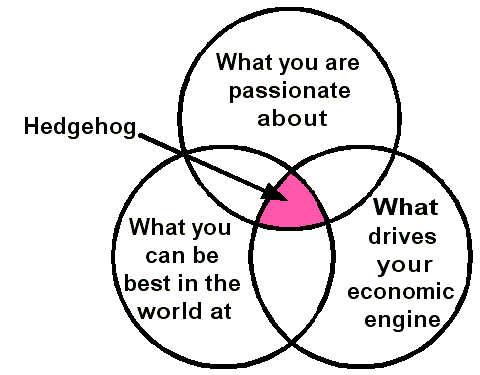
- Hedgehog Concept: Three overlapping circles: What makes you money? What could you be best in the world at? and What lights your fire?
- Culture of Discipline: Rinsing the cottage cheese.
- Technology Accelerators: Using technology to accelerate growth, within the three circles of the hedgehog concept.
- The Flywheel: The additive effect of many small initiatives; they act on each other like compound interest.
- A leader must be of great use
- Good is the enemy of great
- What separates the great from the good, the exceptional from the average.
- If all we have great businesses, we will merely have prosperous nations. They will not be great. In order to be a great nation, we must have great institutions, including schools, hospitals, and churches.
- Jim took a turn to the dark side to look at why some of the greatest enterprises in history fall from great to good to mediocre to bad to irrelevant to gone. If it can happen to them, it can happen to anyone. No company, no church, no nation, no society no individual is immune – anyone can fall.
- The mighty fall through a series of stages – organizational decline is more what you do to yourself than what happens to you.
- Leaders matter – the good to great leaders are different, they are cut from a different cloth.
- Humility is essential for great leadership.
- Packard’s Law – “No company can consistently grow revenues faster than its ability to get enough of the right people to implement that growth and still become a great company. [And] If a company consistently grows revenue faster than its ability to get enough of the right people to implement that growth, it will not simply stagnate; it will fall.”
- Jim Collins How The Mighty Fall (page 55-56)
- The number one step is to always regulate growth by the question – do we have all our key sets filled with fantastic people? If not, we must resist growth until we have them.
- Get the right people on the bus and then figure out where to drive the bus!
- Is your Team on the way up or a team on the way down?
- Preserve the core and stimulate progress.
- You must never confuse faith and facts. You must face the most brutal facts.
- Greatness is a cumulative process that requires continual discipline.
- You can be in late stage 4 and you can still come out of decline.
- You measure your success by money, you will always lose.
- What would be lost if we disappeared? What would fill the space we left?
- The signature of mediocrity is not the inability to change, it’s chronic inconsistency. – Jim Collins
- Great companies succeed because they have a reason to endure.
- Great companies will not compromise on their values and purpose; their core values are not open for compromise.
- The test of a first-rate intelligence is the ability to hold two opposed ideas in mind at the same time and still retain the ability to function.
F. Scott Fitzgerald - We need big, hairy, audacious goals.
TO DO LIST:
1. Do your diagnostics – the Good/Great Diagnostic tool. Confront the brutal facts of where you can do better.
2. Count your blessings – literally, in a spreadsheet. Don’t stop until you get to at least 100.
3. Double your questions to statements ratio. Ask the right questions.
4. How many key seats do you have on the bus? How will you get to 100% of the seats filled with fantastic people?
5. Do a “Teams on the Way Up-Teams on the Way Down” Diagnostic
6. With a team of right team assembled, create an inventory of the brutal facts.
7. Make a “Don’t Do List”
8. Define results and focus on milestones
9. Double your reach to young people by changing your practices without changing your core values
10. Set a Big Hairy Audacious Goal. Remind yourself that your work is never done.
Never capitulate, never give in!


Peter Ferdinand Drucker - "The Man who Invented Management"
 Management is doing things right; leadership is doing the right things. - Peter F. Drucker.
Peter Drucker Quotes:
· Almost everybody today believes that nothing in economic history has ever moved as fast as, or had a greater impact than, the Information Revolution. But the Industrial Revolution moved at least as fast in the same time span, and had probably an equal impact if not a greater one.
· In all recorded history there has not been one economist who has had to worry about where the next meal would come from.
· Management by objectives works if you first think through your objectives. Ninety percent of the time you haven't.
· Management is doing things right; leadership is doing the right things.
· Plans are only good intentions unless they immediately degenerate into hard work.
· Quality in a product or service is not what the supplier puts in. It is what the customer gets out and is willing to pay for. A product is not quality because it is hard to make and costs a lot of money, as manufacturers typically believe. This is incompetence. Customers pay only for what is of use to them and gives them value. Nothing else constitutes quality.
· So much of what we call management consists in making it difficult for people to work.
· The computer is a moron.
· The most important thing in communication is to hear what isn't being said.
· There is nothing so useless as doing efficiently that which should not be done at all.
· We now accept the fact that learning is a lifelong process of keeping abreast of change. And the most pressing task is to teach people how to learn.
· Innovation is the specific instrument of entrepreneurship... the act that endows resources with a new capacity to create wealth.
"Management" means, in the last analysis, the substitution of thought for brawn and muscle, of knowledge for folklore and superstition, and of cooperation for force.
Quotes: Interest vs Commitment

“There's a difference between interest and commitment. When you're interested in doing something, you do it only when circumstance permit. When you're committed to something, you accept no excuses, only results.” - Kenneth Blanchard
“Unless commitment is made, there are only promises and hopes; but no plans.” - Peter F Drucker
Joke: Attitude towards work (Japanese vs Middle Eastern)
Just a joke from the internet. Not to be taken seriously :) (I have worked in the Middle East before and it was great. I do understand the culture and the people there, to an extent)
Japanese attitude towards work:
If one can do it, I can do it.
If no one can do it, I must do it.
Middle Eastern attitude towards work:
Wallahi, if one can do it, let him do it.
If no one can do it, ya habibi, how can I do it?


New Air Jordans cause shopping frenzy as doors are boken, arrests made
From the link: http://ca.finance.yahoo.com/news/air-jordans-cause-shopping-frenzy-112610222.html

Statement issued by Nike in response to the violence (What a sham!):

Statement issued by Nike in response to the violence (What a sham!):
"Consumer safety and security is of paramount importance. We encourage anyone wishing to purchase our product to do so in a respectful and safe manner."
My response? This violence phenomenon has already occurred once in 1984. If you really cared about the youth, Nike, you would not let it repeat again. Why limited edition? Why not a mass production and release? Why not plan in advance?
This is BAD PR for Nike. If someone had died, it would have been unforgivable. Where is your CSR (Corporate Social Responsibility), Nike? You need to do better than this!
This is BAD PR for Nike. If someone had died, it would have been unforgivable. Where is your CSR (Corporate Social Responsibility), Nike? You need to do better than this!


Stock Market Bubble
Source: Wikipedia
A stock market bubble is a type of economic bubble taking place in stock markets when market participants drive stock prices above their value in relation to some system of stock valuation. Behavioral finance theory attributes stock market bubbles to cognitive biases that lead to groupthink and herd behavior.
Subscribe to:
Posts (Atom)