
This blog documents my MBA student life at Ryerson University, Canada (2010-2012). It was an attempt to demystify the MBA experience, help understand MBA topics & encourage MBA wannabes. I have a Pre-MBA blog about B-School application process (and a few other blogs) as well. I used to blog actively in the past and interact with readers regularly, but life got very busy after my MBA. Good luck. Take care. Cheers! Gerry.
Tuesday, February 28, 2012
100 Potential Interview Questions - from Monster.com
From the link: http://career-advice.monster.ca/job-interview/interview-questions/100-potential-interview-questions-canada/article.aspx
Tell me about yourself.
What are your strengths?
What are your weaknesses?
Who was your favorite manager and why?
What kind of personality do you work best with and why?
Why do you want this job?
Where would you like to be in your career five years from now?
Tell me about your proudest achievement.
If you were at a business lunch and you ordered a rare steak and they brought it to you well done, what would you do?
If I were to give you this salary you requested but let you write your job description for the next year, what would it say?
Why is there fuzz on a tennis ball?
How would you go about establishing your credibility quickly with the team?
There's no right or wrong answer, but if you could be anywhere in the world right now, where would you be?
How would you feel about working for someone who knows less than you?
Was there a person in your career who really made a difference?
What's your ideal company?
What attracted you to this company?
What are you most proud of?
What are you looking for in terms of career development?
What do you look for in terms of culture -- structured or entrepreneurial?
What do you like to do?
Give examples of ideas you've had or implemented.
What are your lifelong dreams?
What do you ultimately want to become?
How would you describe your work style?
What kind of car do you drive?
Tell me about a time where you had to deal with conflict on the job.
What's the last book you read?
What magazines do you subscribe to?
What would be your ideal working situation?
Why should we hire you?
What did you like least about your last job?
What do you think of your previous boss?
How do you think I rate as an interviewer?
Do you have any questions for me?
When were you most satisfied in your job?
What can you do for us that other candidates can't?
What are three positive things your last boss would say about you?
What negative thing would your last boss say about you?
If you were an animal, which one would you want to be?
What salary are you seeking?
What's your salary history?
Do you have plans to have children in the near future?
What were the responsibilities of your last position?
What do you know about this industry?
What do you know about our company?
How long will it take for you to make a significant contribution?
Are you willing to relocate?
What was the last project you headed up, and what was its outcome?
What kind of goals would you have in mind if you got this job?
Give me an example of a time that you felt you went above and beyond the call of duty at work.
What would you do if you won the lottery?
Can you describe a time when your work was criticized?
Have you ever been on a team where someone was not pulling their own weight? How did you handle it?
What is your personal mission statement?
Tell me about a time when you had to give someone difficult feedback. How did you handle it?
What is your greatest failure, and what did you learn from it?
What irritates you about other people, and how do you deal with it?
What is your greatest fear?
Who has impacted you most in your career, and how?
What do you see yourself doing within the first 30 days of this job?
What's the most important thing you've learned in school?
What three character traits would your friends use to describe you?
What will you miss about your present/last job?
If you were interviewing someone for this position, what traits would you look for?
List five words that describe your character.
What is your greatest achievement outside of work?
Sell me this pencil.
If I were your supervisor and asked you to do something that you disagreed with, what would you do?
Do you think a leader should be feared or liked?
What's the most difficult decision you've made in the last two years?
What do you like to do for fun?
Why are you leaving your present job?
What do you do in your spare time?
How do you feel about taking no for an answer?
What was the most difficult period in your life, and how did you deal with it?
What is your favorite memory from childhood?
Give me an example of a time you did something wrong. How did you handle it?
Tell me one thing about yourself you wouldn't want me to know.
Tell me the difference between good and exceptional.
Why did your choose your major?
What are the qualities of a good leader? A bad leader?
What is your biggest regret, and why?
What are three positive character traits you don't have?
What irritates you about other people, and how do you deal with it?
If you found out your company was doing something against the law, like fraud, what would you do?
How many times do a clock's hands overlap in a day?
How would you weigh a plane without scales?
What assignment was too difficult for you, and how did you resolve the issue?
If I were to ask your last supervisor to provide you additional training or exposure, what would she suggest?
If you could choose one superhero power, what would it be and why?
What's the best movie you've seen in the last year?
Describe how you would handle a situation if you were required to finish multiple tasks by the end of the day, and there was no conceivable way that you could finish them.
What techniques and tools do you use to keep yourself organized?
If you could get rid of any one of the provinces, which one would you get rid of, and why?
With your eyes closed, tell me step-by-step how to tie my shoes.
If you had to choose one, would you consider yourself a big-picture person or a detail-oriented person?
If selected for this position, can you describe your strategy for the first 90 days?
Who are your heroes?
Tell me 10 ways to use a pencil other than writing.


Answering Behavorial Interview Questions ---> When The Interviewer Asks You “Give me an example of when you…”
From the link: http://career-advice.monster.ca/job-interview/interview-questions/answering-behavioral-interview-questions-canada/article.aspx
It’s common for interviewers to focus more on your past behaviours than on future situations. They might make a request of you to “Please give me an example of a situation that required you to make a good decision quickly. How did you react, and what were the outcomes?”
The Past Is a Predictor of Future Behaviour
An assumption being made in this line of questioning is that how you’ve acted in the past is the best indication of what you’ll do in the future. Whether or not this is entirely true, you are best off to prepare for behavioural interview questions.
The way to answer this type of interview question is in the form of a brief story that relates to question that you have been asked. The story should be no longer than a minute or two. It can be broken down into three distinct parts: a description of The Situation, a summary of the Actions that you took, and highlights of the Results that you achieved.
Become A Storyteller
Here are the three parts, in more detail, of a reply to behavioural questions.
Here’s an example from an interview with a potential salesperson at a toy manufacturing company, using the following bullet point from an applicant’s resume:
• Designed a new in-store promotion based on input from the store owners. Boosted sales by 20% above initial projections.
Now, here’s how the job interview might go.
Interviewer: How have you made sure that you’ve met your sales quota when helping to launch a new product?
Job Seeker:
Starts with Situation. “Hmmm…well, back at Playtime Inc., we launched a new doll based on a character from “The Addams Family” movie. Sales weren’t anywhere near what we’d hoped for after the first three months.
Shifts to Actions. “So I went out and met with buyers from three of our other key accounts to determine what the problem was. Based on their input and that of the store owners, I worked with our marketing department to re-design the in-store sales material and we created a contest.”
Finishes with Results. “After that, sales jumped up within three months to 20% above what we’d budgeted. My boss was so happy she put a letter of congratulations in my file. Here, I brought a copy to show you.”
Keep The Story Short and Punchy
See? All it takes is a quick story about a relevant accomplishment. Structure it in three parts, including the Situation, Actions and Results. Tell the story with confidence and enthusiasm.
Then when you’re finished answering the behavioural question – STOP TALKING. Let the interviewer probe further if they want to.
It’s common for interviewers to focus more on your past behaviours than on future situations. They might make a request of you to “Please give me an example of a situation that required you to make a good decision quickly. How did you react, and what were the outcomes?”
The Past Is a Predictor of Future Behaviour
An assumption being made in this line of questioning is that how you’ve acted in the past is the best indication of what you’ll do in the future. Whether or not this is entirely true, you are best off to prepare for behavioural interview questions.
The way to answer this type of interview question is in the form of a brief story that relates to question that you have been asked. The story should be no longer than a minute or two. It can be broken down into three distinct parts: a description of The Situation, a summary of the Actions that you took, and highlights of the Results that you achieved.
Become A Storyteller
Here are the three parts, in more detail, of a reply to behavioural questions.
- The SITUATION: What was happening at the time? What was the nature of the problem or opportunity?
- The ACTIONS you took: Describe what you did, either personally or as part of a team, to solve the problem or take advantage of the opportunity.
- The RESULTS: Describe how your efforts paid off. Try to quantify in specific terms wherever possible.
Here’s an example from an interview with a potential salesperson at a toy manufacturing company, using the following bullet point from an applicant’s resume:
• Designed a new in-store promotion based on input from the store owners. Boosted sales by 20% above initial projections.
Now, here’s how the job interview might go.
Interviewer: How have you made sure that you’ve met your sales quota when helping to launch a new product?
Job Seeker:
Starts with Situation. “Hmmm…well, back at Playtime Inc., we launched a new doll based on a character from “The Addams Family” movie. Sales weren’t anywhere near what we’d hoped for after the first three months.
Shifts to Actions. “So I went out and met with buyers from three of our other key accounts to determine what the problem was. Based on their input and that of the store owners, I worked with our marketing department to re-design the in-store sales material and we created a contest.”
Finishes with Results. “After that, sales jumped up within three months to 20% above what we’d budgeted. My boss was so happy she put a letter of congratulations in my file. Here, I brought a copy to show you.”
Keep The Story Short and Punchy
See? All it takes is a quick story about a relevant accomplishment. Structure it in three parts, including the Situation, Actions and Results. Tell the story with confidence and enthusiasm.
Then when you’re finished answering the behavioural question – STOP TALKING. Let the interviewer probe further if they want to.
Ten Interviewing Rules
From the link: http://career-advice.monster.ca/job-interview/interview-preparation/ten-interview-rules-ca/article.aspx?wt.mc_n=CRMCA000255
By Carole Martin
Monster Contributing Writer
In the current job market, you'd better have your act together, or you won't stand a chance against the competition. Check yourself on these 10 basic points before you go on that all-important interview.
1. Do Your Research
Researching the company before the interview and learning as much as possible about its services, products, customers and competition will give you an edge in understanding and addressing the company's needs. The more you know about the company and what it stands for, the better chance you have of selling yourself in the interview. You also should find out about the company's culture to gain insight into your potential happiness on the job.
2. Look Sharp
Select what to wear to the interview. Depending on the industry and position, get out your best interview clothes and check them over for spots and wrinkles. Even if the company has a casual environment, you don't want to look like you slept in your outfit. Above all, dress for confidence. If you feel good, others will respond to you accordingly.
3. Be Prepared
Bring along a folder containing extra copies of your resume, a copy of your references and paper to take notes. You should also have questions prepared to ask at the end of the interview. For extra assurance, print a copy of Monster's handy interview take-along checklist.
4. Be on Time
Never arrive late to an interview. Allow extra time to arrive early in the vicinity, allowing for factors like getting lost. Enter the building 10 to 15 minutes before the interview.
5. Show Enthusiasm
A firm handshake and plenty of eye contact demonstrate confidence. Speak distinctly in a confident voice, even though you may feel shaky.
6. Listen
One of the most neglected interview skills is listening. Make sure you are not only listening, but also reading between the lines. Sometimes what is not said is just as important as what is said.
7. Answer the Question Asked
Candidates often don't think about whether they are actually answering the questions their interviewers ask. Make sure you understand what is being asked, and get further clarification if you are unsure.
8. Give Specific Examples
One specific example of your background is worth 50 vague stories. Prepare your stories before the interview. Give examples that highlight your successes and uniqueness. Your past behavior can indicate your future performance.
9. Ask Questions
Many interviewees don't ask questions and miss the opportunity to find out valuable information. The questions you ask indicate your interest in the company or job.
10. Follow Up
Whether it's through email or regular mail, the interview follow-up is one more chance to remind the interviewer of all the valuable traits you bring to the job and company. Don't miss this last chance to market yourself. It is important to appear confident and cool for the interview. One way to do that is to be prepared to the best of your ability. There is no way to predict what an interview holds, but by following these important rules you will feel less anxious and will be ready to positively present yourself.
By Carole Martin
Monster Contributing Writer
In the current job market, you'd better have your act together, or you won't stand a chance against the competition. Check yourself on these 10 basic points before you go on that all-important interview.
- Do Your Research
- Look Sharp
- Be Prepared
- Be on Time
- Show Enthusiasm
- Listen
- Answer the Question Asked
- Give Specific Examples
- Ask Questions
- Follow Up
1. Do Your Research
Researching the company before the interview and learning as much as possible about its services, products, customers and competition will give you an edge in understanding and addressing the company's needs. The more you know about the company and what it stands for, the better chance you have of selling yourself in the interview. You also should find out about the company's culture to gain insight into your potential happiness on the job.
2. Look Sharp
Select what to wear to the interview. Depending on the industry and position, get out your best interview clothes and check them over for spots and wrinkles. Even if the company has a casual environment, you don't want to look like you slept in your outfit. Above all, dress for confidence. If you feel good, others will respond to you accordingly.
3. Be Prepared
Bring along a folder containing extra copies of your resume, a copy of your references and paper to take notes. You should also have questions prepared to ask at the end of the interview. For extra assurance, print a copy of Monster's handy interview take-along checklist.
4. Be on Time
Never arrive late to an interview. Allow extra time to arrive early in the vicinity, allowing for factors like getting lost. Enter the building 10 to 15 minutes before the interview.
5. Show Enthusiasm
A firm handshake and plenty of eye contact demonstrate confidence. Speak distinctly in a confident voice, even though you may feel shaky.
6. Listen
One of the most neglected interview skills is listening. Make sure you are not only listening, but also reading between the lines. Sometimes what is not said is just as important as what is said.
7. Answer the Question Asked
Candidates often don't think about whether they are actually answering the questions their interviewers ask. Make sure you understand what is being asked, and get further clarification if you are unsure.
8. Give Specific Examples
One specific example of your background is worth 50 vague stories. Prepare your stories before the interview. Give examples that highlight your successes and uniqueness. Your past behavior can indicate your future performance.
9. Ask Questions
Many interviewees don't ask questions and miss the opportunity to find out valuable information. The questions you ask indicate your interest in the company or job.
10. Follow Up
Whether it's through email or regular mail, the interview follow-up is one more chance to remind the interviewer of all the valuable traits you bring to the job and company. Don't miss this last chance to market yourself. It is important to appear confident and cool for the interview. One way to do that is to be prepared to the best of your ability. There is no way to predict what an interview holds, but by following these important rules you will feel less anxious and will be ready to positively present yourself.
Robert Kiyosaki and his principles / teachings - do they make true business sense to an MBA?
 "Don’t work hard for money;
 Instead, have money work hard for you"
- Robert Kiyosaki.
I have been a fan of Robert Kiyosaki for almost a decade now - after reading his book "Rich Dad, Poor Dad". To me, as a non-MBA, then, it made me curious about Financial Literacy.
After I began my MBA, I now begin to wonder how much of it is true and how much false. I would love to do an analysis in one of my future posts about this topic. Some of his thoughts - like the cash flow quadrant, however, do make sense.
If I apply his thoughts to MBAs who graduate from business schools, I get the feeling that this could translate to: "Rich MBA, Poor MBA", LOL :)))
Here are some relevant videos:
As per Kiyosaki's teachings, there are 4 types of people: E, S, B & I. (Employees, Self Employed, Business owners & Investors). And their thinking / psychology is as below:
- Employees: "I am looking for a safe secure job with benefits". Core value --> Security.
- Self Employed / Small Business owners / Solo: "If you wan't it done right, do it by yourself".
- Big Business Owners: "Good system, good network, smartest people I know, to help run my business." They do not want to run their companies themselves; They want smart people to run their companies for them.
- Investors: These people make money work for them (not people work for them - like in the other 3 categories.)

The 2 dads had 2 different sets of values and advise.
- What the Poor Dad said: Go to school, get good grades, get a high paying job, work hard, live below your means, save money, get out of debt, have a good retirement plan.
- What the Rich Dad said: That (stuff said by the poor dad) will not make you rich! Get into business. Generate assets that will last for a long time and you can even pass on to your next generation. (But if your are on a job, you don't own anything and you could get fired at any time)
One thing is for sure - Kiyosaki and team are masters of Marketing. They know how to sell their books, their seminars, their courses and their products well - mostly to the layman who has no much knowledge of business priniciples. And they do a goood job too. But the problem is that not everyone who attends the seminars eventually goes on to use the principles. I know quite a few such people.
I found some more information at this link: http://nat-n-hatch.com/tag/rich-dad-poor-dad/ . And I quote below:
- According to Rich Dad (and Poor Dad), there are two main types of income: Earned income & Residual income (including passive income and portfolio income).
- Your earned income is what you earn by working. Your job, for example, is an earned income. If you stop working (quit, are let go, etc), you will stop earning that income.
- Residual income is what your earn with not direct involvement from you. Of course, you need an initial effort, but once it's going good, it's going, and doesn't stop (usually). A good example of a passive income is income derived from real estate or from your paper assets (bonds, mutual funds,etc).
- Residual income can be difficult to create, and the key is to be alert for residual income opportunities.
- The other main discrepancy between Rich Dad and Poor Dad is that Rich Dad will spend his money on assets while Poor Dad will spend his money on liabilities, without understanding the difference. For example, while a new car is an asset to Poor Dad, that same new car is a liability to Rich Dad. This is the reasoning behind it:
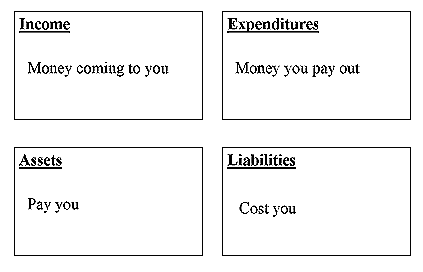
- An Asset is something that will pay you back, by producing income.
- A Liability is something that will cost you money, by causing expenditures.
- So when you buy a new car, what happens? You spend money. Similarly, when you purchase a new house in the suburbs or a new TV, you spend money, by creating a monthly mortgage payment or monthly credit card payments. And as people make more money, they tend to buy more goods and services on credit, increasing the amount of debts.
- This is where investing in other types of assets become interesting - the residual income. You need to purchase assets that will create a streaming income. Over time that residual income will become greater than you earned income (job), allowing you to become independently wealthy.

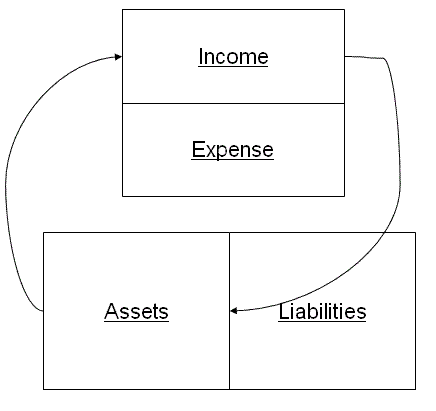 |
| Why the Rich ger Richer... |
More points from the link above:
- Rich Dad’s Lesson #1 “The poor and the middle class work for money. The rich have money work for them.”
- Assets put money into your pocket,
- Liabilities take money out of your pocket.
- The rich buy assets
- The poor only have expenses
- The middle class buys liabilities they think are assets (house, car, furnishings, boat etc)
- The problem many people have is that they focus too much on generating income instead of focusing on buying income generating assets
- The advantages of forming a corporation, namely tax advantages and protection of personal assets.
- Kiyosaki makes the argument, that you should choose jobs based on what you can learn from them, not how much money you can make.
- Fear
- Cynicism
- Laziness
- Bad habits
- Arrogance
- Have a reason greater than reality.
- Choose daily.
- Choose friends carefully. This is good advice, since you tend to drift towards acting like those you associate with.
- Master a formula and then learn a new one.
- Pay yourself first. You have got to have assets, and if you don’t stash away the cash right as soon as you get it, you will probably spend it.
- Pay your brokers well.
- Be an Indian giver.
- Assets buy luxuries. Kiyosaki is advocating delayed gratification, waiting until your assets generate enough money to pay for the luxuries, instead of buying them right away when you want them.
- The need for heroes. Kiyosaki says his heroes are golf players and financial top dogs.
- Teach and you shall receive. I think this is probably the best advice of the chapter. When you try to teach a subject, you are forced to think more deeply about it. When you can’t explain something and are faced with honest probing questions, you realize exactly where the weak points in your understanding are. The best reason to teach is really to learn.
- - unquote -
It is true that to the masses, Kiyosaki's teachings do make a lot of sense. Before starting the MBA program, I was in awe of his books and did learn a few things. There is a lot of negative talk about him in general, with the mention that he is just a good marketer and it is all about gimmicks, trying to sell his expensive products.
I guess the consumers have to be prudent about spending on courses. But his original book the Rich Dad, Poor Dad, is certainly worth a read for anybody and everybody!
But with regards to Direct Selling business. I do not agree with Kiyosaki. Not everybody can make it - in practical terms. The failure rate is pretty high. I am not saying that the model is wrong. What I mean is that it is not possible for every single individual participating in direct selling to make big bucks - the number of drop outs and failures speak for themselves. However, there are people who are socially active who do go on to become successful.
Another thing that I disagree with, is that Kiyosaki tends to downplay the contribution of employees. Employees of corporations run the world and provide us with most of the services. Being an employee is not shameful. There are companies that take good care of their employees and pay them well. The residual income from employment salaries can be invested to generate passive income - that is possible too.
- Gerry.
"WHITE SPACE" ---> I bet you have heard of Blue Ocean. But what the heck is "White Space" in Business? ---> Part of "Design Thinking"
From the link: http://continuuminnovation.com/design-thinking.aspx#inlineContentb465bc7c-f3c2-468c-8269-65c3236b6426
FINDING THE WHITE SPACE:
FINDING THE WHITE SPACE:
Vibrant businesses are constantly looking for new ways to deliver value. They monitor how our evolving culture changes what is expected; how new technologies change what is possible; and how existing expertise can be applied to other markets. They look for white spaces in the business ecosystem: opportunities that are just emerging and not yet clearly articulated.
Herman Miller followed this path and extended its office furniture brand into a new business category. Healthcare. By analyzing and understanding patient and caregiver needs, they transformed the feel and functionality of the hospital room and captured new market share in the process.
Design thinking helps uncover business innovation.
Herman Miller followed this path and extended its office furniture brand into a new business category. Healthcare. By analyzing and understanding patient and caregiver needs, they transformed the feel and functionality of the hospital room and captured new market share in the process.
Design thinking helps uncover business innovation.
So there, MBAs! Now you know! :)))
White Spaces (in the business ecosystem) ---> Business opportunities that are just emerging, but not yet clearly articulated.
For MBAs, the Retail sector is attractive and in high demand, but for Companies, Hiring & Retention is key.
From the link: http://economictimes.indiatimes.com/news/news-by-company/corporate-trends/CEOs-and-HR-heads-looking-at-hiring-and-retention-as-a-challenge/articleshow/11384369.cms
CEOs, Human Resources heads and talent managers are looking at hiring and retention as a challenge. They describe here what they've inherited, and what they can look forward to in the new year
"CONSISTENCY AND DISCIPLINE ARE KEY "
Kishore Biyani
Founder and Group CEO, Future Group
Talent Scenario : Over time, we will see many more talented people from other sectors, including FMCG and consumer goods, join retail.
Talent War : While attrition on the management side tends to be low, on the front-end, the scene is different. For many people, this tends to be their first job, so they stay on or leave depending on how much they like it.
Profiles in Demand : Overall, there is still a paucity of talent in areas like operations and specialised functions including merchandising, category management and the like. There's still a demand for good talent across sectors.
CEOs, Human Resources heads and talent managers are looking at hiring and retention as a challenge. They describe here what they've inherited, and what they can look forward to in the new year
"CONSISTENCY AND DISCIPLINE ARE KEY "
Kishore Biyani
Founder and Group CEO, Future Group
Talent Scenario : Over time, we will see many more talented people from other sectors, including FMCG and consumer goods, join retail.
Talent War : While attrition on the management side tends to be low, on the front-end, the scene is different. For many people, this tends to be their first job, so they stay on or leave depending on how much they like it.
Profiles in Demand : Overall, there is still a paucity of talent in areas like operations and specialised functions including merchandising, category management and the like. There's still a demand for good talent across sectors.
Germany is now more attractive than UK for foreign professionals ---> due to Germany's new liberal immigration policy (while UK begins to close its doors?)
From the link: http://economictimes.indiatimes.com/news/nri/working-abroad/liberal-immigration-policy-berlin-could-soon-become-more-attractive-than-london-for-young-indians/articleshow/12034647.cms
 The perception of Germany is changing. From a land of engineering and football to an education and employment destination. Germany's attraction for the 22-year-old engineer from Delhi is not just limited to high-quality technology education and research.
The country's living and working conditions are also a big draw. "Tuition fees are almost zero and there are many internship openings. My course is in English and on completion, I expect many opportunities to find a suitable job here," says Khurana. He is currently studying for a master's degree in communication engineering at Technical University of Munich.
Blue Card Advantage
Young Indians, both students and professionals, stand to gain a lot from two new Bills which the German government is looking at. The first one, introduced in December 2011, makes permanent residence (PR) for highly skilled professionals from overseas much easier by lowering the minimum annual income for a PR permit from 66,000 euro to 48,000 euro.
Overseas students, too, will gain under the new Bill with unrestricted access to the labour market and no minimum income requirement. While those engaged in academic research would have a simplified procedure for temporary residence, their family members will get the right to unrestricted gainful employment.
In addition, Germany has also revived the idea of the EU Blue Card, which will facilitate the entry of highly qualified non-EU nationals and their families into the EU countries. The Blue Card will further lower the minimum income requirements to 44,000 euro and 33,000 euro in specific jobs such as mathematics, engineering, natural sciences, IT and medicine.
"It is expected that the proposed legislation will be passed without any major changes and become a law this year. Germany welcomes top-qualified professionals from abroad, in particular engineers, computer specialists and doctors," the acting German ambassador in Delhi, Meier Klodt, told ET on Sunday.
The easing of immigration rules for non-EU citizens is in keeping with Germany's record lows in unemployment and huge skills shortage, which is being seen as a big advantage for young Indian professionals. A recent survey by Germany's federal employment research agency, IAB, showed a total of 1.13 million positions vacant.

UK Closes Doors
But it's not just the German positives that are drawing Indians. What has highlighted the need for a new European hub for Indian immigrants is the UK's recent move to make immigration laws more stringent. There are many thousands of Indian students in the process of enrolling in colleges in the UK, who are a worried lot.
The UK is closing down its popular two-year post-study Tier-1 work visa for foreign students, from April 2012. Till 2010, student visa allocation in India, for the UK, declined by 6% and the UK Border Agency confirms that changes in the student visa rules will result in even fewer student visa applications in 2012. The post-study work visa helped many students from India to recover the high cost of education by working in UK after studies.
"The UK government's cap on skilled immigration has already done a lot of damage and now the decision to scrap the post-study leave to stay comes as a big blow," says Karan Bilimoria, a member of the British House of Lords and on the board of Cambridge University's Judge Business School. Experts fear that the number of applications to UK's institutions of higher education from India could go down by as much as 30% in 2012.
"In the UK, the possibility of landing a permanent job is minimal now. You will probably have to make 30-40 applications to get shortlisted for a couple of interviews. Without the post-study visa, one can't put in even a primary application," says Leena Tandon (name changed on request), who is doing an internship in London after finishing her post-graduation degree in communications.
Most of her classmates from India are doing the same hoping that the internship will get them an entry route into the UK job market. "From this year, international students will have to devote a lot of time to finding placements which provide a visa as soon as they finish their degree," she adds.
The perception of Germany is changing. From a land of engineering and football to an education and employment destination. Germany's attraction for the 22-year-old engineer from Delhi is not just limited to high-quality technology education and research. The country's living and working conditions are also a big draw. "Tuition fees are almost zero and there are many internship openings. My course is in English and on completion, I expect many opportunities to find a suitable job here," says Khurana. He is currently studying for a master's degree in communication engineering at Technical University of Munich.
Blue Card Advantage
Young Indians, both students and professionals, stand to gain a lot from two new Bills which the German government is looking at. The first one, introduced in December 2011, makes permanent residence (PR) for highly skilled professionals from overseas much easier by lowering the minimum annual income for a PR permit from 66,000 euro to 48,000 euro.
Overseas students, too, will gain under the new Bill with unrestricted access to the labour market and no minimum income requirement. While those engaged in academic research would have a simplified procedure for temporary residence, their family members will get the right to unrestricted gainful employment.
In addition, Germany has also revived the idea of the EU Blue Card, which will facilitate the entry of highly qualified non-EU nationals and their families into the EU countries. The Blue Card will further lower the minimum income requirements to 44,000 euro and 33,000 euro in specific jobs such as mathematics, engineering, natural sciences, IT and medicine.
"It is expected that the proposed legislation will be passed without any major changes and become a law this year. Germany welcomes top-qualified professionals from abroad, in particular engineers, computer specialists and doctors," the acting German ambassador in Delhi, Meier Klodt, told ET on Sunday.
The easing of immigration rules for non-EU citizens is in keeping with Germany's record lows in unemployment and huge skills shortage, which is being seen as a big advantage for young Indian professionals. A recent survey by Germany's federal employment research agency, IAB, showed a total of 1.13 million positions vacant.

UK Closes Doors
But it's not just the German positives that are drawing Indians. What has highlighted the need for a new European hub for Indian immigrants is the UK's recent move to make immigration laws more stringent. There are many thousands of Indian students in the process of enrolling in colleges in the UK, who are a worried lot.
The UK is closing down its popular two-year post-study Tier-1 work visa for foreign students, from April 2012. Till 2010, student visa allocation in India, for the UK, declined by 6% and the UK Border Agency confirms that changes in the student visa rules will result in even fewer student visa applications in 2012. The post-study work visa helped many students from India to recover the high cost of education by working in UK after studies.
"The UK government's cap on skilled immigration has already done a lot of damage and now the decision to scrap the post-study leave to stay comes as a big blow," says Karan Bilimoria, a member of the British House of Lords and on the board of Cambridge University's Judge Business School. Experts fear that the number of applications to UK's institutions of higher education from India could go down by as much as 30% in 2012.
"In the UK, the possibility of landing a permanent job is minimal now. You will probably have to make 30-40 applications to get shortlisted for a couple of interviews. Without the post-study visa, one can't put in even a primary application," says Leena Tandon (name changed on request), who is doing an internship in London after finishing her post-graduation degree in communications.
Most of her classmates from India are doing the same hoping that the internship will get them an entry route into the UK job market. "From this year, international students will have to devote a lot of time to finding placements which provide a visa as soon as they finish their degree," she adds.
Subscribe to:
Posts (Atom)